ABOUT
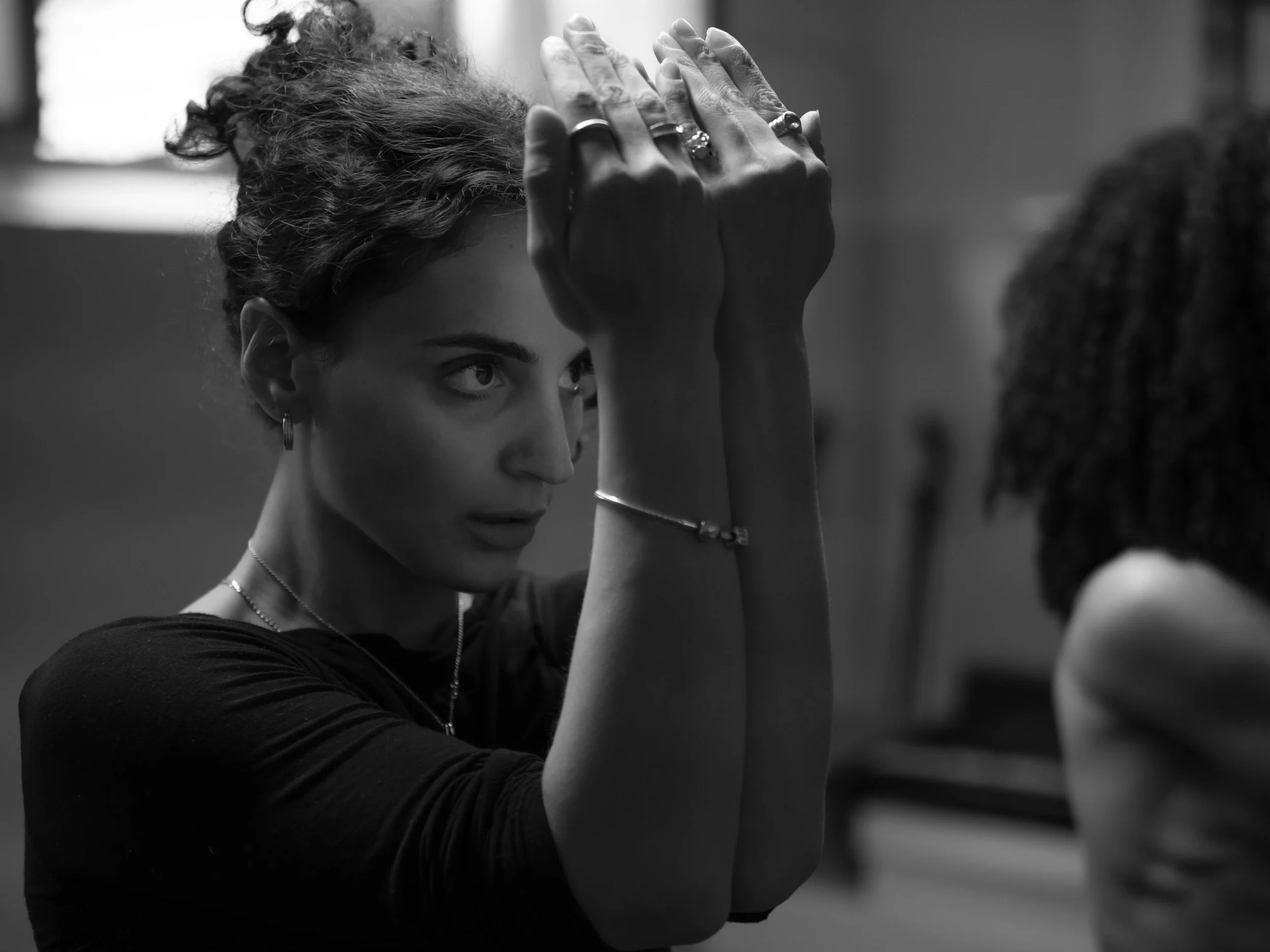
Caterina Danzico is an Italian-born and raised performer, teacher, and choreographer based between the UK and Italy, whose work spans performance, installation, and commercial work. She holds a master’s in fine arts in Choreography from the University of Roehampton, and her choreographic works have been presented in different theatres and institutions such as Megaron - The Athens Concert Hall (Athens), Stam Europa (Bruxelles), The Place (London), Teatro Greco (Rome), amongst others.
Her training started at a young age, in the dance school directed by her mother in Verona (Italy), followed by her professional studies in Rome under the direction of Enzo Celli. She has attended NOD (Nuova Officina Danza) in Turin as a scholarship holder, where she has extensively studied Batsheva repertoire and gaga technique.
Since 2021, she has become increasingly established within the London dance scene, collaborating with prominent choreographers including Benoit Swan Pouffer (director of Rambert Company), Harry Price, BlackHaine, Charlotte Edmonds, Alexandra Green and others. In 2020, she collaborated with Every Island Collective on WELCOME: (a) ceremony in Brussels and developed AMAMI, her first screen dance project.
In 2024, she choreographed the performance Knives and Forks, which received the Best Direction award at the Bitesize Festival. In 2025, she collaborated with architect and scenographer Alessandro Cugola on Leaking Bodies at the Jan Van Eyck Academy.
She is currently continuing her choreographic research in Verona, where she created the duet Tirocinium In Animo, which premiered in summer 2026 at Teatro Satiro OFF, Forte San Briccio and Bridge Film Festival.
Choreographic statement
In prehistoric societies, communal dance was typically associated with rites of passage, burial, trance, shamanic practices and later agricultural ceremonies. Dance was not yet autonomous. Its value was primarily operative. During the 15th and 16th centuries, the Renaissance brought court dances to royal palaces in Italy and France. With the emergence of complex societies, specialised performers and eventually the professional dancer, another relationship developed: movement became something increasingly separated from communal function and offered to the gaze of others. The division between performer and spectator became more pronounced. Dance became increasingly capable of existing as an art form in itself.
My choreographic research begins from that historical fracture: between the ritual body, which moves because movement must accomplish something, and the trained/theatrical body, which moves for someone to watch. I want to bring these two conditions together. I am interested in choreography as a real rite of passage as well as a ‘representation’ of one. I am interested in how dance has transmuted in our society, and how that original purpose is still paradoxically present despite its absence.
Mythology (Greek, Roman or Egyptian) has been an endless source of inspiration in my work for the past 6 years. I find myths to be crude stories, filled with tragedy, sorrow, and revenge, yet deeply poetic and engulfed by an ever-present closeness to the human experience, which extends beyond time and space. I’m interested in how these stories have persistently survived over the centuries, resisting the fragility of collective memory, as I believe they contain potent symbolism and profound possibility for self-knowledge. Within the context of dance, I am interested in how to physicalise archetypal characters, and choreograph how the self is never univocal but multiple, fractured and paradoxical. Translating myths into choreographic partiture is an enriching and challenging process, which intertwines with my spiritual quest.
The never-ending questions about the presence and absence of the divide often surround my work. In my personal life, I hold a vivid curiosity for the great monotheistic religions. I am inspired by the Christian Catholic religion, with its traditions and sacred text, as well as mysticism and early Christianity. I was born and raised by a catechist mother, who has been running a dance school in the building next door to our local church. For the first 18 years of my life, I danced in that church on various occasions: weddings, Christmas recitals and so on. This somewhat imposed proximity gave me at times the most profound experiences while dancing, while also instigating a great zeal to leave the borough and learn more about dance in the ‘real world’. Perhaps because of this history, I remain deeply interested in the re-enactment of Christian rituals through choreography. I often look at choreographic “profanity”, not as iconoclastic gestures, but for decontextualization: by removing a ritual, image or figure from its established religious framework, we are able to encounter it with a new sensitivity.
Although I see Christianity as paradoxically resistant to mythology, both traditions have nevertheless produced powerful mythological figures (such as Cain and Mary Magdalene) who continue to fascinate me and recur throughout my work.
From a movement standpoint, I am interested in the Feldenkrais method as a base for my work. Feldenkrais - awareness through movement - is a gentle & slow movement practice which focuses on skeletal movement pattern development as a way to utilise less muscle effort, as well as enhancing awareness of movement. At the same time, I am passionate about Ballet and the classical tradition of dance, which inspires my movement palette. Combining Ballet with consistency in movement awareness is the spinal cord of my choreographic practice. During the creation and the repetition of a piece, I challenge myself and the dancers to constantly remain aware of the skeleton, muscles and inner sensation, while striving for precision, refinement and effortlessness in their movement. The inner landscape of each movement is as vital as the outside form.
Finally, during the last years, my main inquiry regarding dance and choreography has been to seek answers to the following questions:
What’s the role of dance in today’s society? How can I contribute to the development of this form? In what ways can contemporary dance become more accessible to a wider audience? How can I make my work a vehicle for a deeper awareness both for the dancers as well as the audience?